Tuesday, February 20, 2007
Crushing

Monday, February 19, 2007
Red Vs. Blue; America too Damned Religious?

Sunday, February 18, 2007
Reply to Steve

Lately I've been struck at the total absence of meaning in people's lives. Steve, doesn't the fact that 150 million of your neighbors don't "believe" in evolution put the same thought into your mind that Camus had right before he swerved his car into a tree?
Is there anything more strikingly nihilistic that such a mass of people who consider themselves to be "God's" chosen are less honest and more in the dark than thojse who don't even believe in a god?
Lately I've been struck at just how senseless life is. How we put meaning into the cycles of time when they just blow the dust of our ancestors around without care. I am looking out my windown now and can faintly see the road in the distance and I can't imagine a speckle of a hint that there is any god present. Ask the woman last week whom, after 3 miscarriages in a row had to be informed that her 20 week fetus was alive, but had trisomy 18, a lethal chromosomal abnormality which was worse than if they baby were already dead. Should she take it to term and let it be born and watch the deformed husk of tormented innocent life suffocate? Or should she have someone inject pottassium chloride into its heart to stop it with a needle through her belly and then pass it?
This is triply fucked. Father, Son, and Holy Ghost- the triad of the throbbing God-Head.
Is this learning lessons Steve? Is this forcing this woman and her tormented husband to learn from the mistakes of their last incarnation?
I look down the road and I can't see the faintest fucking speckle of god anywhere but in children's fantasies, anoxia, delusion, self-deception, Emerson's Alzheimers if you know what I mean- the collapse of a Brilliant fleshly spirit.
I know, you wake up at age 30 and realize that every inkling of what you lived for all your life is now as believable as Narnia. I suppose one of my greatest pieces of dumstruckedness that I'm capable of conjuring up is looking back at my life in hindsight and realizing that I had no real free-will, muddling over the most absurd spiritual quandaries which seem to me now like a heated conversation between a schizophrenic and himself over whether or not the voices are real.
Linda Stewart. Enough said.
Fortunately I know you're not driving now, otherwise you might destroy a tree.
Now maybe you can see why my lack of belief is not a heartless personal assault as you intone at least two or three times a week in your emails. I find chaos slightly more humane actually. Imagine the carnage from the train wreck of the potentiality that there actually were a God, a plan, a purpose. How many infinite times must people endure the pointless futility of ignorance filled life-spans? Across the universe, how many beings are suffering, and for what?
The debate boils down to one issue in my opinion, divided into three groups:
1. Those who don't understand natural selection
2. Those who understand it but can't deal with the implications.
3. Those who understand it and can't deal with the implications but don't try to ignore the implications.
I shit on buddhism, new ageism, and of course Christianity and Islam. What obscene bastardizations of reality! The chaos of trying to organize the world within the constructs of false mythic fantasy is a greater, more painfully barbed and disombobulated torture chamber than simple raw and crisp chaos itself.
And you're the one who thinks I'm the torturer?
Friday, February 16, 2007
Awesome
Wednesday, February 14, 2007
Sophisticated Courtier's Reply

Tuesday, February 13, 2007
Bumper Sticker

Saturday, February 10, 2007
Pentagon Manipulated Intel

Thursday, February 08, 2007
Copernican, Galilean
" ....Even when it comes to compassion and self-transcendence, there is new wine (slowly) being poured. Why not catch it with a clean glass?
All the best, Sam"
What brilliance, this writer. What command of language. It's breathtaking. As one person wrote on another blog concerning Harris- "Galilean. Copernican."
Revolutionary. Better than Russell.
I think that the undeniably crisp piquancy of Sam Harris' logic leaves people with the choice to either understand him or to distort him. To any discerning human being with any interest at all, the words are like barbs of honesty- things which any reasonable person knows to be true already, but things which people of faith have been trying to dilute and run away from with tricky word games all their lives.
Also, this lecture is Sam's best. The first part you have heard many times. But video two is awe inspiring. This is reality put out into the open for the emperor's devoted tailors.
Tuesday, February 06, 2007
Haggard on Sex

Saturday, February 03, 2007
Mickey Quits the Military
Comedic Entertainment
Because He Says So

Saturday, January 27, 2007
Blasphemy "Debate"

Tuesday, January 23, 2007
Globe Trotters Vs. Washington Generals


Monday, January 22, 2007
Pinker the Stinker

Unafortunadamente, creo todos que dice aqui.
Yes, I believe everything Pinker says here. I think NDEs are no more evidence for LAD than schizophrenic episodes. I think consciousness is extinguished with death. I think that the radio analogy does not work, because the core signal can be altered by tampering with the brain, whereas the core signal cannot be altered by tampering with a radio. Therefore, it seems logical that the brain creates conscious experience. Every single thing we learn about the brain points to this conclusion. No number of amazing spiritual experiences adds up to an iota of a reason to believe otherwise, without tangible evidence. There is none, never has been any, and I think it's safe to say there never will be any. Long after our deaths, the materialist position will be the only viable position left as new information accumulates. Only the ignorant or the uneducated will still believe that spiritual experiences argue for a transcendent soul. By the turn of the century I predict that it will be effectively proven (in the same way that the non-existence of Zeus has been effectively proven to all reasonable people) that there is no human soul.
Sullivan Proves Harris' Points

Saturday, January 20, 2007
Zen

Only a Zen master could write the following:
The Courage to Question
"Spiritual seekers are some of the most superstitious people on the planet. Most people come to spiritual teachers and teachings with a host of hidden beliefs, ideas, and assumptions that they unconsciously seek to be confirmed. And if they are willing to question these beliefs they almost always replace the old concepts with new more spiritual ones thinking that these new concepts are far more real than the old ones."
Hahaha, a complete debunking of every popular spiritual teacher. Now, if only zen masters learned something about neuroscience and biology they could be great atheist scientists.
Adyashanti (above) wrote that. Funny thing is, if you take all of the bullshit out of spirituality and religion, there's literally nothing left-
emptiness.

Adyashanti debunking humanity
"There's no solution in your born nature, only adaptation"
"Your body and mind is nothing but conditioning. If conditioning drops out of your body and mind we call it death"
Shit, he's just Dawkins without the education.
Thursday, January 18, 2007
Harris vs. Sullivan Debate

VermontBard, you must have designed this thing yourself! Andrew Sullivan is having an open email debate with Sam Harris on beliefnet. The debate is concerning religious modernism with Sullivan seemingly in defense of it. This is not as hostile as the Dennis Prager fiasco (so far) as both agree on the problem with religious fundamentalism. The opening salvos were not salvos, just clarifications. Sam's second post is clearly argued and beautifully written and I am forced as always to just wholeheartedly agree with him- why not just utterly dispense with Christianity entirely?
If Sullivan is going to try using Christianity as his moral template or his template for universal "mystery", he has to cherry pick to the extreme. After so much cherry picking, at what point does a reasonable person just admit that the entire thing is unnecessary? As Harris points out, they could develop a better spiritual system in the course of an email exchange than the entire bible offers. I just can't see any reason to be a moderate within the "great" religions, and I think it is indefensible. And I think that Sullivan is probably rare amongst the moderates he is defending. His reply post should deliver his best argument to change Harris' mind (and mine).
Saturday, January 13, 2007
If I Had to Do it Again

Hometown Embarrassment

Tuesday, January 09, 2007
Hopelessness

When I look at an infant, when I see a mother holding a child, when I witness the humanity and compassion of people, a loving family like the one that supports you...I cant help but think that that enduring love comes from something, it doesn't come from reason, I think it comes from God, but you think that love comes from evolution?
Monday, January 08, 2007
Demerol & Xanax
I was losing my consciousness and I was completely aware of it. But I was not afraid. I thought, "So this is what it is like to die. This isn't that bad!"
Then I felt a great, loving warmth, an intensely bright light, and a presence. Telepathically, I heard the presence say, "Well Cheryl, what do you think now?"
I knew exactly what the question meant. It was a reference to neglect of my spirituality.
My years of practice in ED and med/surg had made me cynical, made me lose faith in God. I just could not understand why good people had to die such untimely or horrible deaths, or suffer needless trauma at someone else's hands. My inability to reconcile my faith with the horrors I saw made me leave hands on nursing for utilization review. But when that presence spoke, I immediately came to a realization. It wasn't that God deserts us in our time of need. Rather, he is there for us when we die; we are not alone.
With this new understanding I begged to go back to my life on earth. And the presence agreed.
I remember waking up so joyful. I couldn't wait to tell others what I had learned. But I couldn't share my experience with anyone right away - not even the nurse who had remained by my side throughout the ordeal. When I finally did tell her, two days later, she was so positive and supportive I felt relieved. But when I told my doctor he dismissed me and my story. He said the whole experience was caused by Demerol, and wrote me a new order for Xanax.
Sunday, January 07, 2007
My Mother Has a Classic OBE

Last night I went to my parent's house to watch the Seattle Seahawks. I brought beer, because I expected it to be the last game of the year for this battered and beat up pale shadow of a team from what they were last year. They won one of the strangest, most dramatic games I've ever seen. And something else happened that was strange.
My mother was reading a book and she looked up and said "Oh, I had an out of body experience the other night". I knew she wasn't kidding, the way she said it. My mother knows nothing at all about OBE's. She only knows that I have had a big interest in OBE's and NDE's.
She had a classic OBE. Laying in bed, she heard the cat whining at the door. Most people who have cats know how they whine at your bedroom door in the morning. She wanted to get up and open the door and felt an intentional desire to do so. Suddenly her entire body started to tingle. Next moment she found herself "hovering" by the bed, fully aware of the cat whining and my dad snoring next to her (he snores like a banshee). She was sort of surprised that she was so aware of the cat and the snoring even in this state.
My mother currently has dyed short blonde hair.
The first thing she did "out of body" was panic and start screaming. She could mentally feel herself screaming out of sheer panic, but there was no sound of her screaming. Then she felt her long brown hair wisp over her face as she was screaming. She felt her body was younger as well. Interestingly, when she was younger she did have long brown hair. A believer in the reality of astral projection would point out that most OBErs have an astral body like they had in their youth. I would suggest that after a certain age, people still see themselves as how they were when they were younger. My mother was suddenly in her body again. Nothing else happened.
I find 3 things fascinating. She felt the classic tingling vibrations that immedately preceed most OBE's people describe. Second, she found herself hovering. Why not standing? Maybe because there is no sensation of pressure on the feet people immediately assume they are floating. Third, she was in a youthful body again, althought she admits that she did not think to observe her body.
Important fact- my mother does not give a shit about religion, OBE's or NDEs and she generally leaves the room and goes somewhere else when my dad and I start talking about something like this.
The Grasping Nature of Faith

Saturday, January 06, 2007
Lies of Lying Liars and the Liars Who Tell Them
Dear Readers – Some of you may have noticed an article about me that is now running on Alternet.org. The writer, John Gorenfeld, has taken a ninety minute telephone interview, along with selective passages from my books, and made of them a poisonous of mash of misquotation and paraphrasis for the purpose of portraying me as an evil lunatic. While some level of innocent distortion can be expected in print interviews, this case appears genuinely malicious. You can find Gorenfeld’s account of me here. Please feel free to post comments of you own to the site. If you want to alert the management at Alternet of your displeasure, the contact page can be found here. As you will see, Gorenfeld distorts my views on torture, spiritual experience, and the paranormal. For the record, I have summarized my views on these subjects on my website.
Wednesday, January 03, 2007
The Courtier's Reply

"...The God Delusion, a book that never squarely faces its opponents. You will find no serious examination of Christian or Jewish theology in Dawkins's book (does he know Augustine rejected biblical literalism in the early fifth century?), no attempt to follow philosophical debates about the nature of religious propositions (are they like ordinary claims about everyday matters?), no effort to appreciate the complex history of interaction between the Church and science (does he know the Church had an important part in the rise of non-Aristotelian science?), and no attempt to understand even the simplest of religious attitudes (does Dawkins really believe, as he says, that Christians should be thrilled to learn they're terminally ill?)."
-Orr.
From Dawkins' website:
"I'm afraid that when I read H. Allen Orr's criticism of The God Delusion in the NY Review of Books, all that popped into my head was a two-word rebuttal: Courtier's Reply. You would be amazed at how many of the anti-Dawkins arguments can be filed away under that category.That's all you'll get from me on Orr's complaint—it's another Courtier's Reply. If you want a more detailed dissection, Jason Rosenhouse provides it.
The Courtiers Reply
Monday, January 01, 2007
Response to William Tully
William TullyThe Reverend William McD. Tully has been rector of St. Bartholomew's Episcopal Church in New York City since September 1994. The first professional calling of the "On Faith" panelist was to journalism, and he worked as a copy boy and local reporter at the Los Angeles Times.
"OnFaith" carried another response by notable professionals to a particular question of whether we can have a dialogue. Richard Dawkin's piece was particularly hillarious. He spends have his essay questioning whether we can have a dialogue between Athorists and Vallhallans, and that we need to consider and be respectful to the believers in thinking that lightning is from the mighty hammer as opposed to electrical charges in the clouds, which is afterall, just a theory. I responded to this William Tully essay with a forceful statement. I don't dislike Mr. Tully at all, but I think it's time we treated the question exactly as Dawkin's has in reference to Thor. It's time for people to stand up en masse and say that we are no longer going to stand silent in the face of this horrible self-abuse of literalism. It's time to call a spade a spade. I've made a New Years resolution to do this in my private life to friends and family. Not forcefully, but just point of fact- making it known that I do not believe in these things and that I do not have, nor should I feel obliged to have, respect for these beliefs.
Aaron:
All religious people struggle with their faith. Otherwise they would not need such strong reinforcement from their church communities. It certainly takes faith to believe in a deistic god or pantheism. But to believe in a theistic God takes ignorance and self-deception.
I often wonder how an educated grown adult could not move from theism to at least some form of deism or pantheism like I did as I grew up and learned more about the world. Fear is certainly a component. The social glue of a religious belief is another component- strength in numbers, follow the flock wherever they go. As Sam Harris has said, religion allows people to believe by the millions what only a lunatic would believe alone. This idea can be transferred onto many sorts of organizations who ignore obvious reality in order to cohere.
Why do people uphold religious faith in the face of nature's crystal clear refutations? Faith is a unique meme in that it rewards itself for existing without merit. The religious are expected to fight a battle against their own unbelief, and they consider it courageous to continue finding reasons to believe in the face of the obvious.
You will never go to a bookstore and find a book titled "How to lose all your hopes, dreams, aspirations and desire to live in just 15 minutes a day for 30 days". Why? Surely a book like this could be created. It could be well argued, maybe even with more compelling arguments than a book of it's opposite.
But instead, we find books that encourage hope at bookstores. What point is publishing books on hopelessness, even if a case for it could be easily made? Even if it were perfectly clear that nihilism was the most coherent world-view, the bookstores would still be jammed full of books that inspired and gave hope. Exchange the word hope for "faith" and you can see that even if it were perfectly clear that faith in a theistic religion is false (which it is to any unbrainwashed observer), the bookstores would still be packed with books cavalierly refuting honesty.
My point is that there is no intellectual honesty in theistic faith, and this seems to me to be sinful, even in religious terms. Honesty would be to enter a bookstore with the attitude of "I need to learn more about my world so I can decide whether to continue believing in my faith". But for the dishonest believer in religious faith (they are all either dishonest or ignorant by definition), the attitude is "I am struggling with my faith due to the obvious contrary evidence bombarding me from every direction every time I open my eyes, therefore I need to go to the bookstore and fuel my faith, inundating my consciousness with heaps of rationalisations and fact excluding cherry picked balms of forced self-deception that make me feel safe and comfortable, then persuade as many people as I can that this circular loophole of unreason is good because humanity couldn't possibly live without it."
When I read essays like this I can't agree more with Sam Harris in saying that "God's enemies are more honest than his friends".
Dishonesty is a sin.
The religious are caught in a logical bind because it is sinfully dishonest to continue having faith in these things unless one is grossly ignorant.
Posted January 1, 2007 3:01 PM
What Are You Optimistic About?

3 years or so ago I started a personal tradition of reading every entry in "the edge" question center that comes out right at the start of the new year. Even 2 months ago I found myself anticipating this. Notable scientists from a wide variety of fields write a small essay to answer a theme question. One year it was, "what is your dangerous idea?"
This year it is- "What are you optimistic about?".
Saturday, December 30, 2006
There is no God, and Mary is His Mother

"There is no God, and Mary is His Mother"- George Santayana, Catholic atheist.
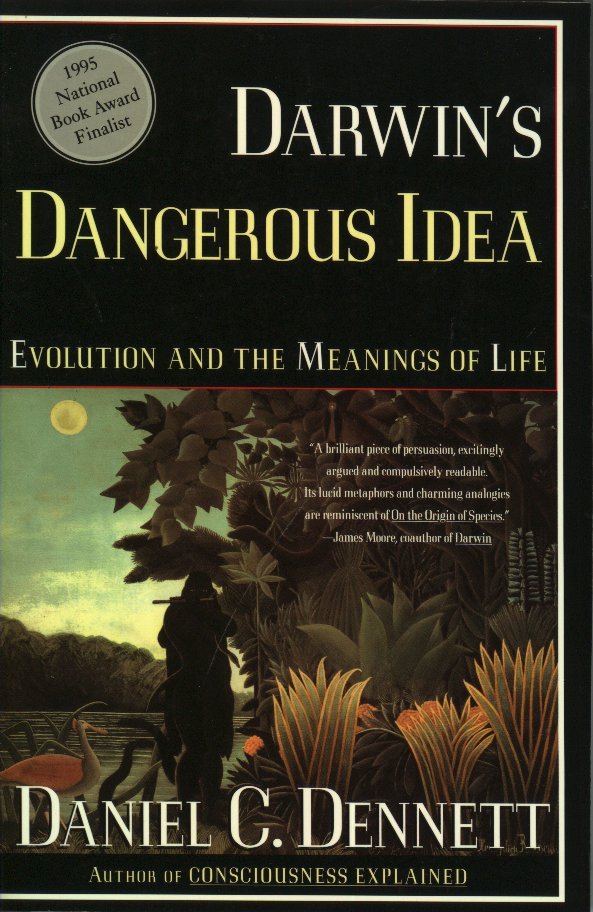
I have finally finished Daniel Dennett's book "Darwin's Dangerous Idea". It was perhaps the most difficult book I've read, or finished I should say. It assumes a lot of knowledge in alot of fields and a broad array of background reading in subjects from Architecture to Artificial Intelligence.
The primary theme of this book centers around "cranes" and "skyhooks". Cranes are building blocks of design that create from the ground up through incremental advances. Skyhooks are deus ex machina of one sort or another (usually over-arching unexplainable "miracles" of design).
This book is primarily a refutation of the attempts to invoke "Skyhooks" to explain life/evolution. From the ground floor, the design of nature seems incredibly complex. Our first intuition is obviously to invoke a great big skyhook to explain it all. But as we inspect the cranes of invention we notice that we can gradually understand how things develop in a way which is non-miraculous (I know, it's called reductionism). Take something like Calculus for example. How could someone possibly determine how much snow fell overnight even though the rate of snow varied throughout the night several times, and varied gradually? From the ground floor it seems impossible to understand Calculus. But when we inspect the cranes of Algebra and Trigonometry, we can see how and why Calculus works, and the miraculousness of it fades away as the cranes are understood.
In debates over nature, people continuously invoke skyhooks whenever explanations fail. The skyhooks are invariably replaced by explanatory cranes, and the critics construct ever more skyhooks to keepsake their precious sense of the mysterious. This book is a refutation of the major historical skyhooks.
The first 105 pages of the book are fairly easy to read and I enjoyed them enough to make a deal with devil at the crossroads that I would finish it. After 105 pages it becomes similar to having a discussion with a very smart schizophrenic who keeps citing books and authors he assumes you already know inside and out, while dancing around like a word-salad in a mirrored rat maze. Daniel Dennett doesn't believe strongly in segues. You might read a thousand words on three different subjects wondering where in the hell he is going, and the payoff is not always sweet or rewarding or particularly enlightening. It's like his editor encouraged him to use as many words as possible to explain even the simplest of points. But in this day and age where critics cherry pick and distorts one's views, it is no wonder why these science books are all over 400 pages long. They hold your hand and slowly say it and repeat it then say it again in another form trying their damnest to make it as hard as possible for someone to mischaracterize their ideas. They will anyways, of course.
There have been many assaults on Darwin's dangerous idea- that there are no skyhooks, only cranes. Even those who accept evolution mischaracterize it or do not really accept that it is all just cranes. Just algorithms. Just selection. Just blind. We look up at the precipice of design and insist a designer, or a conscious inventor of an underlying cosmic principle. But yesterday's skyhook is tomorrows well understood crane.
Dennett comes down hard on Steven J. Gould's attempt to poke holes in orthodox Neo-Darwinism. The press and media were excited that the foremost American evolutionary theorist of his time (Gould) would try punching holes in neo-orthodox Darwinian thought, yearning for a place to store the mysterious skyhook they long for. But over the years according to Dennett, Gould's ideas, though helpful in clarification were not the grand dramatic assault hoped for. Take Gould's famous idea of punctuated equilibrium for example- the idea that slow change isn't explanatory enough to account for evolution, but that evolution happens in fits and starts. Gould hoped to find repositories for skyhooks in this theme, as did the multitudes of mysterian onlookers. According to Dennett, Gould was looking for some extraordinary revolution to pin his name to, and although he clarified certain aspects of evolution, his idea was not revolutionary at all. Overall, the attack on neo-Darwinism by Gould and others has been trounced by the overall scientific concensus. They have clarified issues, but it is still the concensus that Darwin's idea was correct, only now we know it was more correct in more ways than he had imagined. It is still the concensus that cranes are the builders, and the need for skyhooks stems from ignorance and a lack of creativity. There may be a skyhook somewhere, nobody denies this. But there has not been one found yet, despite how eager we are for the supernatural.
Orgel's Second Rule: Evolution is cleverer than you are
Looking up at the peak of design, we lustily invoke skyhooks. Imagine being transported to an advanced alien world where beings of light float in mid-air and communicate telepathically. Who wouldn't invoke skyhooks?
We look at glorious paintings and pieces of music, or my best metaphor- the game of chess, and we think we see the beauty of creativity and expression. Yes they are beautiful and full of clever expression. Reading a chess book once by Josh Waitzken (from searching for Bobby Fisher acclaim) Waitzken talks about the knack for digging into creativity that simple calculative types and mathemitician types are not able to do in the game of chess. There may be something to this idea, but Josh invokes a nebulous skyhook to explain his ability to play well. It implies behind the scenes that there is something more going on in cognition other than the crunching of variations and the drawing from past experiences. It implies a consciousness that is not altogether algorithmic. It implies a skyhook, as Dennett might say. Perhaps this book was old, but I've been following the man vs. machine chess battles, and since the last game between Kasparov and deep blue (Kasparov won the first game but lost the match), the mindless computer algorithms with no creativity whatsoever have been upgraded to the point where they have not only defeated every challenging human in every match, but so far as I know, nobody has even been able to win a single game from the computer since. They have been trounced decisively by an algorithm. Not even a few decades ago, it was commonly thought that chess was too complex a game, requiring too much strategy and long term vision and insight to be cracked by a computer algorithm. That skyhook of Chessic creativity is now another crane. We feel that our best move came from some mysterious intuition, but the algorithm playing behind the scenes in ourheads didn't care to let us in on the details of how it brought our move to cognition so easily. We chalk it up to mystery.

The final chapter of the book is wonderfully written and very readable. I encourage everyone to read these 10 pages. It is not an indicator of how the rest of the book was written, or even it's primary topics, so don't think you should start at page 1 based on the goodness of the final chapter. This book is not for the faint of heart, or anyone who is married. If you have kids and are married, I suggest not even putting this book on your shelf because it could lead to divorce and loss of custody due to inability to hold a job. Watch some sesame street or something, then dig it out of the used book store when you're in your 60's.
Wednesday, December 27, 2006
Monday, December 25, 2006
Tuesday, December 12, 2006
Selfish Gene

I bought my copy of this book recently but am in the midst of Daniel Dennett's painfully diffuse tome "Darwin's dangerous idea". I made a vow to myself to read it through.
I am so greatly looking forward to Dawkins' lucid writing after slaving away through Dennett's verbose Jackson Pollock spewing of loosely related ideas.
If my own personal history is to judge, I will re-read Dennett's book in 5 years and proclaim it to be one of my favorite of all time. But for now, it is sort of like Mr. Miagee's paint the fence, sand the deck. He gives you a work out, but it is very slow to pay off. However, I appreciate Dennett. He is no shallow thinker. He treads deep honest waters and slowly takes you for a mesmerizing swim. It's one of those books that will fundamentally alter my worldview, but in ways which I have yet to quite fully realize. I have to digest it. I don't enjoy reading it, but it is good to read something over your head once in awhile to force you to stretch out and realize how much you don't know.
I also picked up voyage of the beagle, origin of species, and have the ancestors tale as a bathroom book. I'm spread a bit thin with this reading binge I'm on, but I am obsessed with becoming historically informed on evolution because I am fascinated to no end by the complete ignorance of public discourse on the subject, particularly by people like Francis Collins. Also, Naushaba and I were talking about going to the Gallapagos Islands, and one MUST read voyage of the beagle before that.
Anyways, I wanted to post what I thought was a most extraordinary piece of writing. It is review number one from Amazon.com's page on the selfish gene. I think this reviewer speaks for alot of us. Though I've yet to read the book, I am already very familar with the premise. The book landed Dawkins on the map and was considered #9 on the all time most important science books in history (Discover magazine) behind only:
Darwin (Origin of Species and Voyage of the Beagle)
Newton (Principia)
Galileo (Dialogue Concerning the Two Chief World Systems)
Copernicus (On the Revolutions of Heavenly Spheres)
Aristotle (Physica)
Vesalius (De Humani Corporis Fabrica- an anatomy book)
Einstein (Relativity: The Special and General Theory) .
One cannot underestimate the importance of "the selfish gene" by Dick Dawkins. The logic of "the gene's eye view" explains so much and is so clearly obvious, but the implication has devastated many people's satisfying view, including my own. When I believed in a view of guided evolution like Collins has or Ken Wilber has or Andrew Cohen has, I really thought that I understood evolution through natural selection, but I did not. I think the only way to truly grasp that evolution is blind is to do years of field work observing and studying nature like E.O. Wilson and Darwin. The idea has led to strong backlashes by those who insists that nature is not just a blind algorithm. I am at the part in Dennett's book right now where he is attempting to prove that Stephen J. Gould was trying desperately to find a way to show that orthodox neo-Darwinism is not true because the implications of the idea were too unsettling for him to take. Gould never succeeded within the science community at doing this in his lifetime. But Dennett illustrates his frustration that the public is too divorced from facts to realize this. The problem is that the human mind is absolutely unwilling to accept the idea (see my reply to the reviewer's post afterwards)
Fascinating, but at times I wish I could unread it., August 7, 1999
Reviewer: Michael Edwards (Healesville, Victloria Australia) - See all my reviews
I wish I could rate this book at 5 stars and 0 stars at the same time. It is a fascinating book, very well-written, and it conveys a real sense of how life works on the biological level, how all sorts of diverse factors interact with each other to create an incredibly complex system (the evolution of life, in this case); it also just as vividly conveys a sense of how scientists come to understand these processes.
I started it many years ago at the suggestion of a friend, thinking I wouldn't find it very interesting, and not much liking the kind of philosophy of life that (on the basis of my friend's description) seemed to lie behind it. But only a chapter or two in, I was completely hooked, and wanted to read more Dawkins.
On one level, I can share in the sense of wonder Dawkins so evidently sees in the workings-out of such complex processes, often made up of quite simple elemental mechanisms, but interacting so complexly to produce the incredibly complex world we live in.
But at the same time, I largely blame "The Selfish Gene" for a series of bouts of depression I suffered from for more than a decade, and part of me wants to rate the book at zero stars for its effect on my life. Never sure of my spiritual outlook on life, but trying to find something deeper - trying to believe, but not quite being able to - I found that this book just about blew away any vague ideas I had along these lines, and prevented them from coalescing any further. This created quite a strong personal crisis for me some years ago.
The book renders a God or supreme power of any sort quite superfluous for the purpose of accounting for the way the world is, and the way life is. It accounts for the nature of life, and for human nature, only too well, whereas most religions or spiritual outlooks raise problems that have to be got around. It presents an appallingly pessimistic view of human nature, and makes life seem utterly pointless; yet I cannot present any arguments to refute its point of view. I still try to have some kind of spiritual outlook, but it is definitely battered, and I have not yet overcome the effects of this book on me.
Richard Dawkins seems to have the idea that religion and spirituality are not only false, but ultimately unable to give a real sense of meaning and purpose in life. Their satisfaction is hollow, empty, and unreal, in his apparent view, and only a scientific understanding of life can give a real, lasting sense of wonder and purpose.
I would question this. While I am not sure what (if anything) there is spiritually, I know that a scientific view of life cannot offer the slightest hope of life after death, and since we're all going to die and most of us don't want to, this is a crippling drawback to the kind of scientific vision Dawkins wants us all to have. If there is nothing beyond death, no spiritual dimension to anything, and everything is just a blind dance of atoms, I fail to see how this by itself can give one a real sense of purpose, however fascinating the dance that Dawkins describes - and it *is* fascinating; let there be no mistake about that.
Because of this, I have the curious feeling of dichotomy about Dawkins' book that it is certainly fascinating on one level, but that I cannot give even qualified emotional commitment to the outlook on life that seems to lie behind it. I would in the end rather have the hope of something wonderful and purposeful that only some spiritual outlook can offer, even though it may be a deluded fantasy, than the certainty of a scientific vision that eliminates any possibility of long-term hope, that condemns us to an empty, eternal death of nothingness in the end. This scientific view may be completely rational; but rationality is not the only important consideration to shape our outlook on life.
Anyone who has a narrow religious view of life, who is absolutely sure their religion is completely right, would be best off avoiding this book like the plague - it probably won't change their views, but they will quite likely get very upset and outraged. And anyone with an open-minded spiritual view had better at least be prepared to do a lot of thinking, and perhaps be willing to change some of their views, because this book *will* challenge almost any spiritual or religious viewpoint I can think of - whether it is of the open-minded or dogmatic sort.
Some critics of this book have found its reasoning unconvincing, its materialist reductionism too superficial and shallow. But, from my perspective, the problem does not lie here; the problem with the book is that it is *too* convincing, that it is *entirely* convincing. The book makes it very difficult to continue to believe in anything that contradicts its basic premise, but which might be more comforting, and might give a greater sense of hope and inspiration, and provide a real sense of purpose in life.
Such have its effects on my life been that, in my more depressed moments, I have desperately wished I could unread the book, and continue life from where I left off.
It has been said that each of us has a God-shaped hole inside, and that we spend most of our lives trying to fill it with the wrong things. I firmly believe that God-shaped hole is there, that we have inner longings of a wonderful sort almost impossible to describe in words. Whether a God exists to fill it, I do not yet know. But what I am sure of is that, as wonderful as Dawkins' view of nature and of life may be on its own level, it will not fill that God-shaped hole.
Aaron's comment:
I thought this was a wonderful review. It describes what I have gone through as well. Dawkins' ideas not only make sense, they make so much sense that any idea that denies their validity is immediately suspect. In truth, I think that reality leads one to nihilism. Our perception of beauty and grandeur is *also* an illusion set up by our genes. Just as one elephant finds another elephant to be the sexiest imaginable beast, so our concept of "beauty" is equally arbitrary and ungrounded in ultimate reality. All of our imaginable perceptions as human beings are just smoke and mirrors. I've always thought that secular humanists were nihilists in denial. I'm willing to pretend personally. What else is their to do?
Francis Collins is Delusional
"Evolution is God's plan for giving upgrades.You're a fruitfly it doesn't work so well, you need to do more than that. You're a mammal but you still have that thumb that isn't in the right place. Upgrade! You need a bigger brain in order to have your intelligence, upgrade! You need language, upgrade!"
If these statements are not patently absurd to you, you are a creationist. Did the lizard which shoots blood from it's eye have to upgrade from it's prior state of not shooting blood from it's eye? Collins seems to suggest that the dinosaurs were a n experiment that diddn't work so God wiped them out to make way for mammals. This is bordering on psychosis in my estimation. This is a deep and intentional misreading of reality.
Collins shows that a person can be brilliant and inciteful in one area, but terribly misled and forcefully delusional in another. Deciphering the human genome, let me remind you, does not require being informed in evolutionary biology.
Collins believes precisely what he wishes to be true.
He needs to read "The Selfish Gene" by Richard Dawkins. See my next post.
Quote of the Day
Quote of the Day

"I don't see neuroscience as serious. What they have are nutty little theories, and they do elaborate experiements to confirm them and don't know what to do if they don't work. This book [The Emotion Machine] presents a very elaborate theory of consciousness. Consciousness is a word that confuses possibly 16 different processes. Most neurologists think everything is either conscious or not. But even Freud had several grades of consciousness. When you talk to neuroscientists, they seem so unsophisticated; they major in biology and know about potassium and calcium channels, but they don't have sophisticated psychological ideas. Neuroscientists should be asking: What phenomenon should I try to explain? Can I make a theory of it? Then, can I design an experiment to see if one of those theories is better than the others? If you don't have two theories, then you can't do an experiment. And they usually don't even have one."
~ Marvin Minsky Author of "Society of Mind" and the "Emotion Machine". MIT Professor and AI pioneer.
Quoted from Discover Magazine - January 2007